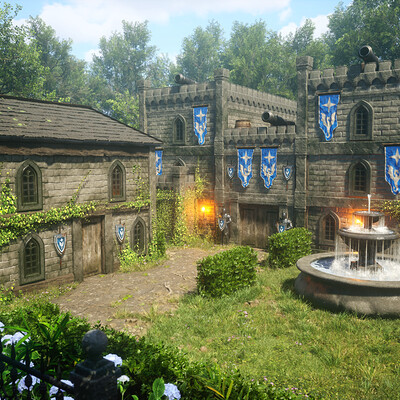
A WIP biking rhythm game where the trail, track, or road is the song. [Please enable sound for the preview video.] Players traverse through beautiful, hand-authored natural terrain at the pace the music sets, with every feature, turn, trick, and more synced to the flow of the music.
Forward motion along the track is a pure function of song time while lateral movement belongs to the player. That single constraint turns level design into a musical charting discipline where very jump, grind, corridor, and obstacle is authored in beat-space and its world position derived mathematically, so a feature placed on beat 64 is guaranteed to arrive on beat 64 regardless of terrain shape or pace.
The design problem I'm solving is a gap in the genre: rhythm movement games ship either abstract geometry with rigorous timing judgment, or naturalistic environments with loose, forgiving judgment. Nobody has combined hand-authored, physically believable terrain with hard rhythmic judgment to the degree that I'm attempting to do with this game. I'm trying to to capture the aweful, epic flow, and spectacle of Sayonara Wild Hearts, but with the tight beat judgement of Guitar Hero/OSU!, played through an on rails setup akin to Subway Surfers and Temple Run.
-Beat-space charting. All content authored as {beat, offset} or beat ranges with beat-keyed curves. One schema across collectibles, grinds, corridors, ramps, and obstacles and all... designing a section means writing music, not placing props.
-A concrete difficulty rule derived from playtesting that ~400 units of lateral travel per beat is the reachable ceiling at the tuned steering speed. Every charting decision expresses as a ratio of lateral distance to available beats.
-Feature vocabulary as musical vocabulary. Collectibles are staccato, trace corridors are legato, grinds span a beat range, obstacles supply the clearance vocabulary that gives hops and jumps purpose. Low and frequent obstacles read as a hop phrase; a large one demands a charged jump.
-No fail state. Skill expresses as score depth creating riskier lines and longer chains so the level's job is to offer readable choices under time pressure, not to punish.
- Upcoming Features -
- Trick System: Perform tricks with a button press while in the air. Repeated presses lead to chained bar turns that end with a 360 on the 3rd. Timing is judged at entry and exit against the bespoke beat pattern of the air time, plus entry modifiers for ramps.
- Obstacle collision: Four classes of obstacles each teaching a different verb: lateral blockers to steer around, low and frequent onces to hop, large ones requiring a charge jump, and overheads requiring a duck.
- Traces aka sustains. A ribbon that the player must follows the inside of for a beat range, judged as continuous lateral positioning. Includes beat offset within the rhythm and width curves to allow for unique shapes that map nicely to the song.
- Grinds: Rails and ledges authored as a beat range with a preset lateral offset path. Timing is judged at entry and exit, with higher value collectibles available on the rail. Specific difficult scenarios made lead to temporary route detours for more points.
- Wheelie mode: A skill vs risk modifier entered by holding the stick back. Floatiness emerges from stick geometry and the constant need to keep the stick back, with reduced authority at the diagonals and mandatory travel through center to switch sides. During a wheelie, movement is more difficult to maintain, but you also get a score multiplier for the duration of the wheelie.
- Setpiece drops: Mandatory, full width routing moments authored as a takeoff beat, a landing beat, and and arc curve. This creates the potential for tense moments at the drop of a song as the player hits the ground out of a huge jump
- Terrain Pinning and Pace Solver: Pin specific parts of the song in world position, solving the pace between any given pins allowing for player movement to increase and decrease throughout the song to ensure that certain parts of the environment are hit on specific intended beats, allowing for environment design to conform to the the music.
- Authoring toolkit: An editor utility that will massive reduce time spent charting. Will include a baked waveform with moveable playhead, ghost rider representing current song time, jump-to-feature navigation, keyboard nudge, feature density debug mapping, and pace curve graph.
- PCG: Proecural scatter is already planned for forest biomes, while the main spline that routes the track will also clear the PCG biomes, and flatten terrain. Planned procedural track editor mode for deep post-launch.
- Visual beat guide. A small corner widget showing bars and a playhead that scales up during air into an approaching ring to trick timing cue.